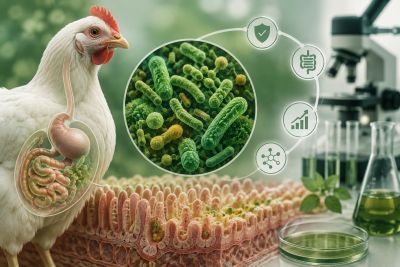
Pioneering work on defined microbial cultures for the control of enteric pathogens in poultry, contributing to the development and commercial application of direct-fed microbial technologies.
Research advancing the use of beneficial microorganisms to support intestinal health, microbial balance, pathogen control, and performance in poultry under commercial conditions.
Translational research integrating microbiology, immunology, nutrition, and gut health strategies to reduce Salmonella colonization and strengthen preharvest food safety in poultry.
Research exploring the interactions among the intestinal microbiome, mucosal immunity, barrier function, and host physiology to better understand resilience, health, and productivity in poultry.
Investigating how diet, feed ingredients, enzymes, organic acids, and other nutritional interventions shape the intestinal microbiome, gut function, and biological performance in poultry.
Bridging laboratory discovery and commercial poultry production by translating microbiome and gut health research into practical, scalable solutions for real-world conditions.
A foundational perspective on how intestinal microorganisms influence digestive physiology, nutrient metabolism, immune development, intestinal barrier integrity, and host health.
Citation
Tellez G, Higgins SE, Donoghue AM, Hargis BM. Journal of Applied Poultry Research. 2006;15:136–144. DOI: 10.1093/japr/15.1.136.
Translational research demonstrating the potential of defined probiotic cultures to reduce Salmonella and other enteric pathogens while supporting poultry performance under laboratory and commercial conditions.
Citation
Tellez G, Pixley C, Wolfenden RE, Layton SL, Hargis BM. Food Research International. 2012;45:628–633. DOI: 10.1016/j.foodres.2011.03.047.
An experimental model demonstrating how diet-induced changes in intestinal viscosity and microbial ecology can compromise gut integrity, promote bacterial translocation, and affect systemic health in broiler chickens.
Citation
Tellez G, Latorre JD, Kuttappan VA, Kogut MH, Wolfenden A, Hernandez-Velasco X, Hargis BM, Bottje WG, Bielke LR, Faulkner OB. Frontiers in Genetics. 2014;5:339. DOI: 10.3389/fgene.2014.00339.
Yang Y, Tellez G, Latorre JD, Ray PM, Hernandez X, Hargis BM, Ricke SC, Kwon YM. Frontiers in Veterinary Science. 2018;5:101. DOI: 10.3389/fvets.2018.00101.
Demonstrating that a defined lactic acid bacteria-based probiotic can reduce Salmonella Enteritidis colonization while improving intestinal barrier integrity, linking microbial intervention with both pathogen control and gut health.
Citation
Prado-Rebolledo OF, Delgado-Machuca JJ, Macedo-Barragan RJ, Garcia-Márquez LJ, Morales-Barrera JE, Latorre JD, Hernandez-Velasco X, Tellez G. Avian Pathology. 2017;46(1):90–94. DOI: 10.1080/03079457.2016.1222808.
Early evidence that dietary modulation can alter the intestinal environment and host response to enteric infection, linking cecal pH and mucosal morphology with resistance to systemic Salmonella invasion.
Citation
Tellez GI, Jaeger L, Dean CE, Corrier DE, DeLoach JR, Williams JD, Hargis BM. Avian Diseases. 1993;37(1):143–148.
We use cookies to analyze website traffic and optimize your website experience. By accepting our use of cookies, your data will be aggregated with all other user data.